

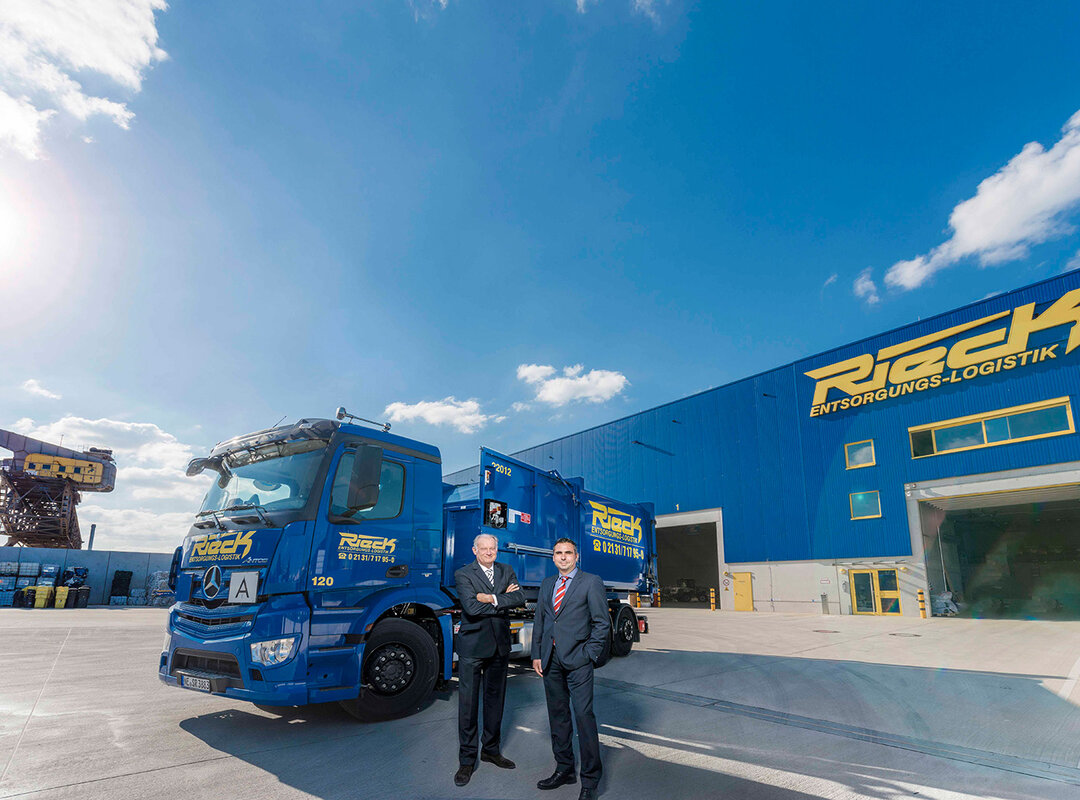
In April 1994, our then smallest Rieck branch in Mülheim a.d. Ruhr enters the waste disposal business with five employees on 700 square meters of hall space. A short time later, it changed its name to Rieck Entsorgungs-Logistik and moved to Neuss in 1999. Today, we offer our customers waste disposal services with a hazardous waste interim storage facility and a wide range of recycling solutions on 40,000 square meters of space and employ 76 people. “The industry is dynamic, and so are we,” says Stefan Rieck, Managing Partner of the Rieck Logistics Group. “Whether it’s new materials, innovative recycling solutions, legal requirements or social rethinking – we keep our finger on the pulse.”
Recycle instead of disposing
Paper, film and plastics used to be waste, but today they are important raw materials. At the same time, manufacturers are being made more and more responsible in terms of a circular economy. And what does this mean for us? We are continuously expanding our recycling capacities accordingly: Ten years ago, the recycling center opened with its own channel baling plant. Last financial year, we sorted, processed and baled more than 30,000 tons of waste paper for the first time. “This year, we are also putting a polystyrene recycling plant into operation,” says Managing Director Daniel Gartmann. It compresses packaging polystyrene – one of the most frequently generated waste materials in the world. The material can then be used as a raw material for the production of new polystyrene, clothing or thermal insulation. We expect to recycle around 16,000 cubic meters in the first year alone.
Everything from a single source
Our customers don’t have to worry about the legal requirements for disposal and recycling: We advise on new developments at an early stage and, as a certified specialist company, ensure that everything runs smoothly.
Another advantage: The Neuss location has its own logistics department, which offers both warehousing options and logistics solutions throughout Germany and worldwide. This is made possible by a modern fleet of box trucks, tautliners, specialized semi-trailers for coil and Joloda transport, and swap-body vehicles—all of which, of course, meet the latest safety standards and Euro standards.
“We are continuing to develop our logistics department’s range of services as well as our diverse disposal and recycling options,” summarizes Stefan Rieck.